The Loopy Effect Loop
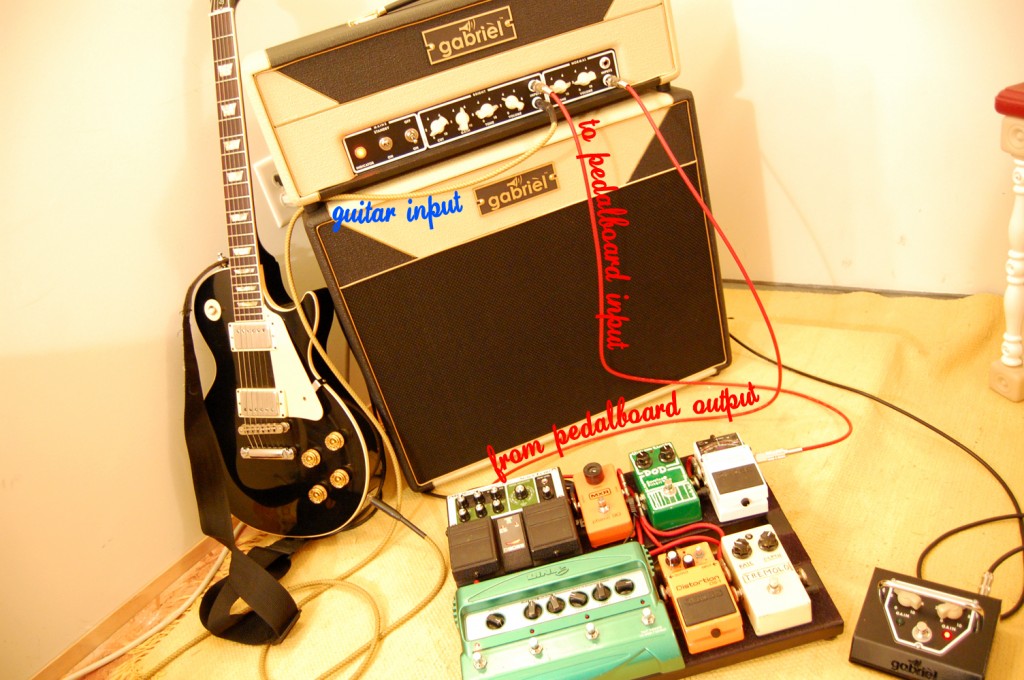
Guitar pedal board routing
Long Live FX Loops (but not in my amps)!
Honestly, I have nothing against effect loops. They have their role in certain high gain amps and do what’s needed to be done greatly: tapping into the preamp output signal, and making it available (via a tube or a solid state buffer to level out any possible impedance mismatches) to external FX processors then returning it in the amp’s power stage.
But if I graft a typical active FX loop as we know it, (and believe me, I tried it) in any of my Low-Gain Gabriel V18 or V33, the tone morphs into something way far from the typical character and dynamics, with a noticeable gain loss that results in a wimpy sound, something that is the last thing on my menu.
High Gain vs Low Gain Amps
Leaving all “class-talk” behind, there are generally two kind of guitar amps on the market today:
High Gain amps, where the signal gets over driven in the preamp, then served further to the power section that does little more than just amplify it. So in a high-gain amp, the majority of the tone characteristics are typically shaped in the preamp.
Here, the effect loop makes great sense since the signal sent to the effect processors has already an identity without loosing anything of its original character.
Low Gain amps where the tone is not saturated in the preamp section (the signal is quite clean at the preamp output) but rather by the power tubes when driven at higher volume levels. This results in a very characteristic overdrive shape distinct to these kind of amps. The Gabriel amps fit in this category.
Now, besides the fact that grafting a buffered effect loop into my low gain Gabriel V18 or V33 might come close to a blasphemy punishable by being burned at the stake, it would make no sense since the clean preamp signal still needs to receive its character and overdrive from the power tubes and an effected preamp output signal will alter the final character of the tone, robbing it of its precious gain and dynamics that’s so needed for the power tubes to do their magic.
The Workaround
As I often mention, the 18 watt Forum is a wealth of information with a lot of folks who are willing share their guitar amp building tips and wisdom. And that’s how I found out about this cool way of wiring your Gabriel V18 or V33 (or 18 watt amp for that matter) so it can simulate a wet/dry scenario of an FX Loop. In fact it is more than a simulation – it is a real effect routing with separate control on the dry and wet signal.
Simply, go with your guitar in the BRIGHT channel, then with another guitar cord, patch in the parallel jack of that same BRIGHT channel (this is your FX Send) and plug it into your FX chain input. The output of your guitar pedal board (FX Return) will go into the NORMAL channel input (I like to use the lower input jack).
This way you control your dry signal with the BRIGHT channel and the wet signal with your NORMAL channel. Simple as that! Diagrams below to help explain:

Pseudo FX Loop Diagram
Now, you can get creative here. You can group your pedals per channel having even more control over the levels.
For instance you can have all your overdrive pedals right in front of your amp going into the BRIGHT channel and have all modulation pedals placed in the FX Loop, going into the NORMAL channel.
This way you have independent control (on the NORMAL channel) over the amount of modulated signal from your modulation pedals grouped within the FX Loop. The guitar signal going into the modulation pedal group FX Loop will already be ‘effected’ by the overdrive pedal group you have going into the BRIGHT channel – but in this routing you control your balance between the over driven and modulated tone. Diagram below that explains what I mean:

FX Loop 2
Yes, the two channels are out of phase on my amps. So if you would patch the two channels directly with a cable, the tone will sound boxy. But when there’s a pedal chain on its path, it really doesn’t matter since the tone is already processed and you cannot perceive the out of phase coloration.
Here’s a detail of the amp channel connection:

It is a very simple setup that literally gives you the same options that an FX Loop would offer but without compromising the tone, or any of the internal circuitry, and having the full rich tone of the overdriven power tubes.


 Facebook Page
 Flickr Photos Sets
 Twitter
 YouTube Channel
 Subscribe to SGT!